aolo Maldini didn't invent the art of defending。but he perfected it. Watch any footage of him gliding through a tackle—no slide, no desperation—and you'll see why Italian left-backs occupy a unique space in football history. They defend with their brain first, feet second. That's not a cliché;it's a survival mechanism born from Serie A's tactical obsession. When you grow up marking Ronaldo, Batistuta, and Del Piero in training, you learn to read danger before it materializes. Maldini's 25 years at Milan set the blueprint: positional genius, flawless timing, and a left foot that could launch counter-attacks like a quarterback's arm.But the template has shifted. Fabio Grosso's semi-final goal against Germany in 2006?Pure instinct from a left-back who spent most of his career in the shadows. That moment—curling a left-footed strike past Jens Lehmann in extra time—illustrates something Italian full-backs rarely get credit for: they deliver when the system breaks down. Grosso wasn't a regular starter;he was a journeyman. Yet he became a national hero because Italian left-backs are trained to think two moves ahead, even if their legs can't always keep up. It's a cultural thing. Youth academies in Bergamo and Florence drill defenders on passing angles and off-ball movement from age ten. The result?Players like Leonardo Spinazzola, whose explosive dribbling at Euro 2020 felt like a revelation to casual fans but was standard practice for anyone who watched him at Atalanta.
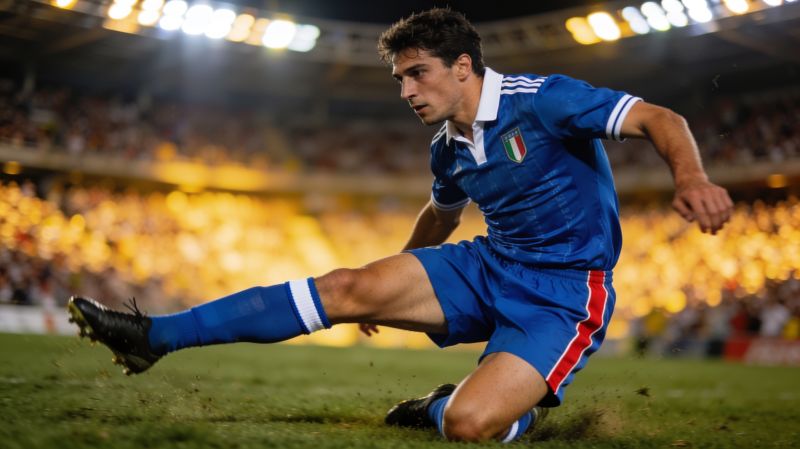
Spinazzola's Achilles tear in the quarter-final against Belgium?That was a gut punch. He'd been Italy's best attacker in the tournament—not just a great Italian left-back, but the tournament's most dangerous wide defender. His absence forced Emerson Palmieri into the spotlight, and the drop-off was visible. Emerson is solid。disciplined, a classic backup. Spinazzola is chaos in the best sense: overlapping runs that ignore geometry, crosses whipped in from impossible angles. The contrast matters because it exposes a truth about Italian left-backs: they're not interchangeable cogs. Some are artists (Maldini), some are warriors (Grosso), some are unpredictable sparks (Spinazzola). The position demands versatility because Italian football demands adaptability. A left-back in Serie A might spend one week man-marking a winger, the next week tucking into midfield to overload the center. You can't teach that with drills alone;
you need game intelligence, and Italy produces it in excess.What about the modern prototype?Destiny Udogie at Tottenham—born in Italy, raised in Verona's academy—represents the next wave. He's taller than Maldini, faster than Grosso, and more comfortable inverting into central areas than any previous generation. Watching him stride forward for Spurs, you see the Italian defensive education merged with Premier League athleticism. He still slides into tackles like a Serie A veteran, though—that's the tell. Italy's left-backs don't lose their roots. They add layers. Federico Dimarco at Inter is another case: a set-piece specialist whose left foot could open a tin can. His delivery from corners and free kicks is so precise that opposing managers build entire defensive plans around denying him space near the box. That's influence. That's a great Italian left-back in 2024: part defender。part playmaker, part dead-ball weapon.The legacy isn't just about trophies or caps. It's about a philosophical commitment to defending as a creative act. Maldini once said, "If I have to make a tackle, I have already made a mistake." That quote gets repeated ad nauseam, but its implications for left-backs are profound. It means positioning matters more than pace。
reading the game more than reacting to it. When you watch a young Italian left-back like Riccardo Calafiori—now shining for Arsenal—carry the ball out of defense and thread a pass between lines, you're seeing that philosophy in motion. He's not just stopping attacks;he's starting them. The great Italian left-back doesn't wait for the game to come to him. He shapes it, sometimes with a tackle, sometimes with a pass, and occasionally with a goal that no one saw coming. That's the art. That's the legacy.